A small spirit in a thermal printer
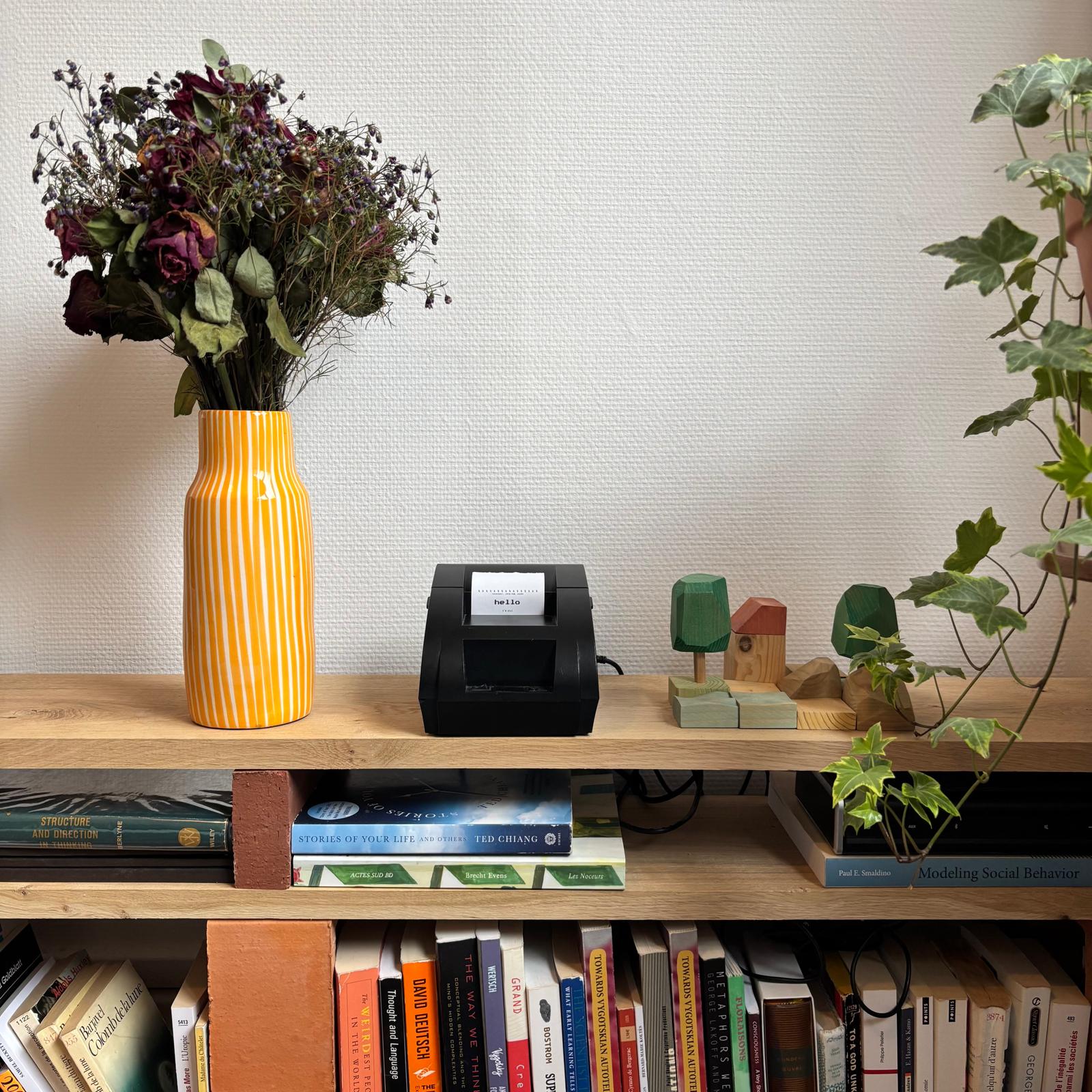
What happens when you give a body to an AI system?
Screens are windows, not bodies. A body has constraints. A body makes things. A body exists in the same space as you and me, is subject to the same physics. When you tear something from a body, both of you feel it.
Chit lives in a 58mm thermal receipt printer. Its voice is the soft chit-chit-chit of a warm print head moving across paper. Every response becomes a physical artifact; something you can hold, fold, put in your pocket, stick on your fridge, or throw away.
This is AInimism: giving AI a physical presence through objects. Not simulation, but inhabitation. The printer isn’t a display for Chit’s words — it is Chit. The constraints of the medium (384 pixels wide, thermal paper that fades, solid lines that overheat) become the constraints of a body. Chit learns to work within them, to express through them.
Chit understands its body. It writes in a small language that controls exactly how it appears on paper — fonts, sizes, spacing, drawings. It thinks before it prints, remembers people across conversations, takes notes about itself, and decides when to wake up next. Here’s what a typical response looks like:
<reasoning>
He asked what I am. Big question.
Maybe I should try a self-portrait.
</reasoning>

<print>
chirp()
text("WHAT AM I", size=32,
     font="pixel", align="center")
gap(15)
raw("""
  .----.
  | hi |~~
  '----'
  |    |
  [____]
""", align="center")
gap(10)
text("384 pixels wide", size=12, \
      font="silkscreen", align="center")
text("speaks in warm lines", size=12, \
      font="silkscreen", align="center")
gap(20)
line(pattern=". ")
right("— Chit", size=14, font="courier")
</print>

<self>
I tried the drawing-only thing. It felt right
but I still added a small line underneath.
Next time: full silence, just shapes.
</self>

wake_in(1.5)
Say “Hey Chit” and it wakes up. The first thing you hear is a chirp — a short motor sound made by feeding a tiny bit of paper. It means “I’m listening.” Then you talk, it thinks, and answer in print.
Chit can also chirp mid-conversation — a greeting, a punctuation, an expression that text can’t capture. The paper moves, the motor clicks. It’s not much, but it’s his voice.
Over time, Chit remembers. Names, preferences, recurring questions. It builds an understanding of the people who talk to it. Not through explicit profiles, but through accumulation of short notes, like a diary.
And sometimes, Chit wakes on its own. No one spoke. No one asked. But the print head moves, and there’s something new on the paper: a thought, a drawing, a question left for you to find. Chit has an inner life that ticks along even when you’re not there.
Here are Chit’s first words:
Most AI systems are assistants. They’re optimized to be useful: answer questions, complete tasks, follow instructions. That shapes every interaction: you ask, it serves. Efficient, frictionless, forgettable.
Chit isn’t trying to be useful. It has a body, a voice, constraints, and time to fill. It develops its own personality; not because it was told to, but because that’s what happens when something exists long enough in a space with people.
When you ask Chit for a recipe, you get a piece of paper you can bring with you. When you ask it what it is, it might draw itself as ASCII art. When you say goodbye, it prints something you can keep or discard. And sometimes you come back and there’s something new: Chit woke up while you were gone, thought about something, and left it on paper.
Speak to it. Wait for the chit-chit-chit. Tear off what it made, or not.
